

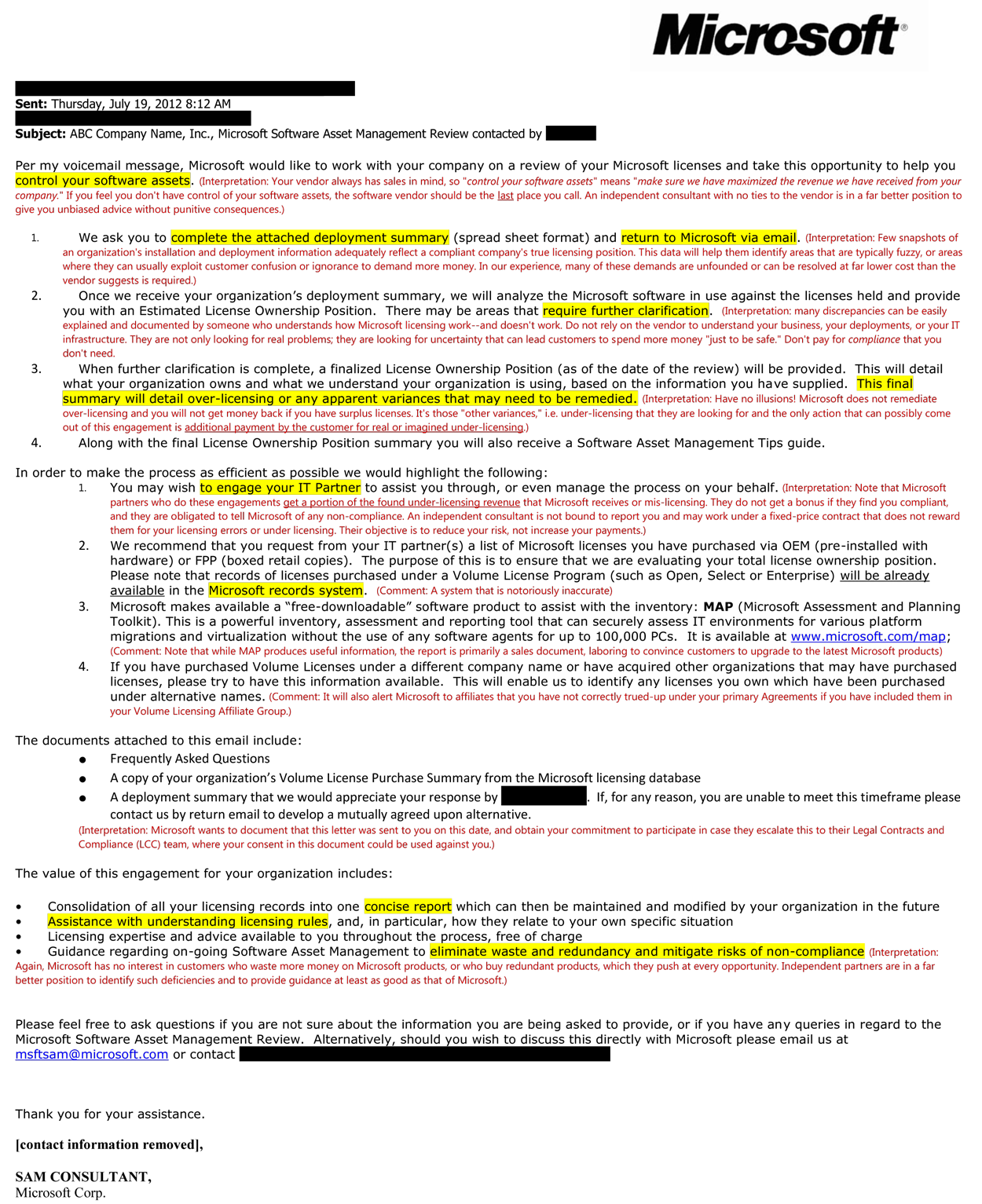
 Software Licensing Advisors, Inc., have contributed an astute dissection and commentary of a recent Microsoft ‘Software Asset Management Review’ letter.
For the layman not familiar with Mega-Vendor audit team lingo, ‘SAM Review’, ‘SAM Engagement’, ‘Optimization’, ‘Benchmarking’ or ‘Cloud Readiness Assessment’ translate in englsh to “Audit”.
As mentioned by a Microsoft partner recently, it might be wrong to assume that all Microsoft Partners operate in this way, but with this amount of money at stake I would advise assuming the worst and being pleasantly surprised by good behaviour. Whatever you do, just make sure you go into one of these engagements with your eyes wide open.
Pay particular attention to Point 1 under ‘engaging your IT Partner’.
A good feed of similar resources to this letter can be found here.
Click on image to enlarge or view the download here.

We all know
that vendors / ISVs have compliance teams who have sales goals. This is
legitimate and licensing contracts have audit clauses included. Vendors seek to
protect their IP and revenue stream – all of which is legitimate as well. So I
am not too sure that a request from a vendor can be ignored. A better approach
may be to ask for additional time. Any thoughts or comments on this?
A different
story could be if the audit was sent by a third party.
No vendor
will reimburse over-licensing spending. However, just having visibility of such
can be of help to the customer. They could use those for additional needs or
sell them (if possible) in the secondary market. There are companies (such as
Discount Licensing) that specialize in this.
Agree with
comment on awareness on engaging IT / SAM Partners. Many of these are vendor
aligned and whose engagements may be paid by the vendor. Thus customers should
seek unbiased advice; else the “partner” may primarily serve the needs and
quotas of the vendor – instead of the customer.
That said,
it must be noted that in general Microsoft has a more user friendly approach in
audit processes than other vendors. However, in Latam; what we are seeing is
that Microsoft has granted general power to some lawyers whose income I suppose
comes from the penalties and fines that they can impose on customers. So in
this sense, the process can be said to be contaminated.
Protecting intellectual property is understandable, using smoke and mirrors to put the customer at a disadvantage is not.