

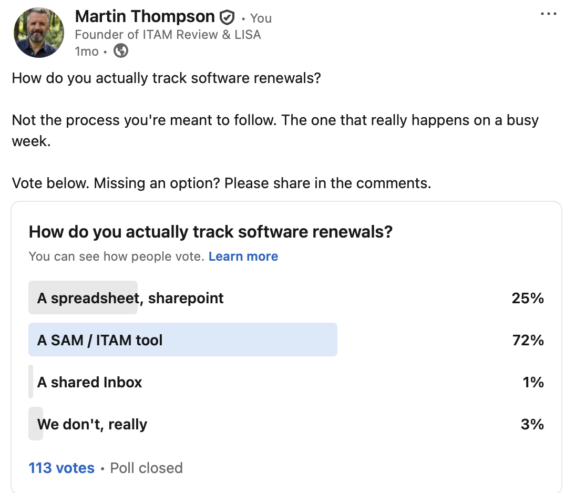
I ran a poll on LinkedIn recently, asking “How do you actually track software renewals?” Not the process you are supposed to follow on the process diagram, but what you actually do on a busy week.
The caveat here: it’s only a LinkedIn poll, and arguably those I’m connected to are going to be more tuned into this than the general IT public at large. But of 113 polled, 72% said they were managing renewals within a SAM tool.
One comment from Brian Ross, a former auditor for publishers such as Veritas, said: “I found that most customers, such as SAM teams, are extremely diligent. However are often a step removed from the actual terms and conditions of the contract, and so therefore don’t know what to actually track.”
Similarly Sandy Vouch, SAM practitioner for a partner, says: “I’ve seen all sorts. Many just wait for their reseller or vendor to prompt them. As you can imagine, that presents all sorts of challenges. Not least of which is the auto-renewal clause that many vendors have silently added to their EULAs.”
Tracking a renewal is not negotiating a renewal
On the face of it the 72% looks like good news, but I’m not convinced. Partly this is down to my poor choice of poll question. I’m not suggesting respondents were lying, but my question measures the wrong thing. Tracking a renewal is not negotiating and executing a renewal in your favour, and it’s likely that your SAM tool is only doing the tracking, not helping with the preparation and execution.
This juxtaposition is supported by BetterCloud’s 2025 State of SaaS report, which suggests that whilst 85% of organisations say they have a formal buying and renewal process, only 30% say it is effective. As we discussed in the Vendor Pressure Index findings back in May, the renewal, perhaps over audit or regular account meetings, is becoming an even bigger pinch point.
The SAM tool is the alarm clock

A SAM tool with a renewals module is like an alarm clock, a forecast of what is on the horizon. It knows the end date, the notice period if somebody entered it, and it might set reminders. This is all great, but it’s often where the tooling stops.
We also need renewal SCRUTINY, and a DECISION.
Will we renew? at what volume? at what tier? with which vendor? all of this backed by the executive power of the system owner or budget holder. All of this is unlikely to be happening in the SAM tool. It happens in email threads, Teams and Slack messages, in budget meetings.
So, when people say we use a tool for renewals, what I think most of them are referring to is a tool that tells us when it’s due. What happens next is anyone’s guess. I’d love to be proven otherwise on this. If you’re using some sort of platform for negotiating or strengthening your renewal process within the technology, I’d love to hear from you.
The renewal process
A renewal decision needs four areas of thought.
Usage against entitlement. Are we consuming what we bought? Zylo’s 2026 SaaS Management Index found licence utilisation running at 54%, up from 47% the year before. It’s an improvement, but it still means that half of the licences we paid for sit idle when we do the renewal.
Business ownership. Someone has to confirm the application is actually still required. Typically in an enterprise, that would be some sort of application owner, and the level of engagement from the asset management team will vary.
Commercial review. Is this the right vehicle for us? Are we on the right tier? Is it even the right vendor? All of those questions create friction in busy lives in busy enterprises, and obviously the easy option is just to renew. Let’s kick the can down the road. I remember watching the presentation from Matt at BT at the event we did at Mercedes-Benz World a few years ago. BT were tasked with removing 20%+ of their IT spend. They did that by doing a default no to all renewals. You had to justify, from a business point of view, what that renewal is for, rather than assuming that the renewal is going to go through. This hard headed approach creates an awful lot of friction but huge savings.
Budget sign-off. The person who owns the cost centre often is not the person who knows whether we’re actually using this thing or getting any value. Reconciling those two takes a little bit of time that your reminder might not cater for.
Cost creep
Renewing as the default used to be a lazy but cheap way of doing things. It isn’t cheap anymore. Gartner reported in October 2025 that enterprise SaaS costs are rising 10 to 20 percent or more at renewal, far ahead of IT budget growth, and Vertice’s 2026 SaaS Inflation Index, drawn from realised increases across thousands of contracts, puts average enterprise SaaS price inflation at 12.2%, roughly five times the consumer inflation rate across the G7. So every contract that rolls over without any scrutiny is factoring in double-digit growth.
Vertice also highlighted that within contract data, 89% of SaaS contracts now include auto-renew clauses. So if you’re on a T-60 notice reminder of a contract renewal, and you’ve got a 90-day auto-renew, your decision’s already made.
We then have the AI uplift multiplier, a new force making that default renewal even more expensive. Tropic’s renewal data across its customer base showed AI-driven price increases from 20 to 37%, against the historic norm of 3 to 9% annual uplift. Vendors are bundling these AI features into core plans, repricing accordingly, and in many cases quietly retiring the old legacy tier, so there’s nothing cheaper to renew onto.
The decision gate alternative
Run a sales pipeline in reverse.
At T minus 12 months, especially for major contracts, that’s the real strategic gate. Does this application still belong in the portfolio? Is the vendor relationship something we want to extend? Is it strategic, is it legacy, is it a commodity, and so forth. This is where alternatives get evaluated, because 12 months is enough time to actually make the switch, which is the only really credible threat that you have in your tool belt.
At T minus six months, we want a commercial gate. Usage data reviewed against entitlement. Volumes rightsized. The AI bundle interrogated line by line. What is included? Is it is metered or measured in some way? Can we opt out of some elements?
At T minus three months, the execution gate. Negotiation is concluded, budget is confirmed, notice is served on anything that’s not surviving.
This swaps us from “let’s renew unless somebody objects” to “let’s justify the renewal”.
The final tip: when you’re running this renewal process, all of your communications with stakeholders and system owners need to be tailored. Addressed specifically for them, how it benefits them, and how it contributes towards their goals. What levers do they have to pull, by when, and how will it benefit them.
I’ll be covering this point and more in the session on the 16th of September, where we’re looking at how you can use AI to help you build a renewals calendar. Join me for that live and interactive session, and we can dig into practical ways to derisk your renewal process.

I still think we need a legal practice course for SAM professionals. Operational SAM is too often left behind prior to presenting data to a commercial/ procurement wing to drive the execution of the renewal. Procurement are too often left to negotiate based on the T&Cs of a contract – they are failing to bring corporate context to the table – ITAM is ideally place to help here.
Recycle
Rationalise
Remove
DO NOT run with the same guess of consumption from the last contract and add x% for inflation.
I agree Martin, I’d go one step further to suggest that we should be looking at a T+ as opposed to a T-. After a decision has been made to buy / renew, consider what the renewal looks like… are there auto renewal clauses, what activities need to happen before this is revisited, when do they need to happen and who needs to be involved.