

Things in IT are cyclical. Trends and ways of working repeat themselves over the years, and ITAM is no exception.
One of the waves and cycles I’ve noticed recently, with the advent of AI chatbots since 2023, is people doing vibe coding around ITAM technology. Vibe coding is whereby somebody with non-coding skills is able to build code using AI.
I’ve seen this with the mainstream ITAM manufacturers, the vendors of tools. I’ve also seen it in new technology that’s being released to the market. And I’m beginning to see it with end-user customers that are building their own solutions.
We’ve been here before
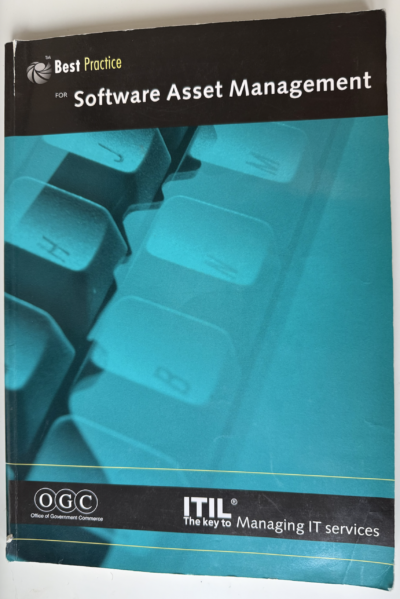
It reminds me of this section from the original ITIL SAM book back in 2003. To put things in context, back in 2003, SAM was not a very common word. People were mostly doing inventory and discovery.
This excerpt from the book mentions the perils and advantages of doing build-your-own ITAM tools, because that was very much a thing at the time. ITAM tools were in their infancy, certainly the ones we know today.
Back then, many organisations would have their own internal ways of working, a custom-built Access database, if indeed they were doing anything at all, using your own homegrown ITAM tools was reality.
1.6.4 Imbalance between ‘customised’ and ‘off-the-shelf’ software perspectives
There is a point of view sometimes expressed that software must always be chosen and tailored to meet an organisation’s unique requirements. This approach can easily be taken to unjustifiable extremes. An organisation’s requirements should certainly be determined before selecting software. However, if those requirements cannot easily be met using existing software packages without customisation, then the requirements should be reassessed. Otherwise, there is a strong risk of software being customised to meet inflexible and poorly thought-out requirements which would result in a costly solution supplied late which does not meet real SAM requirements. Such a solution may represent a bureaucratic and inflexible view of control. By analogy, an organisation that custom-designs its accounting software to meet existing accounting procedures is normally asking for disaster. Unfortunately, the SAM tools available do not yet have the degree of maturity of current accounting and logistical systems, where most major packages provide similar and generally accepted functionality. Current ‘best practice’ in the SAM area is to use a combination of available tools but without extensive customisation. This area will clearly continue to develop.
Best Practice for Software Asset Management, ITIL. 2003, ISBN 0113309430
So we’ve been here before.
With the advent of vibe coding, which removes coding as a barrier to entry, I’m pretty sure a lot of organisations are going to be doing the weigh-up of: is this something we could cook internally rather than buying off the shelf?
That applies not just to ITAM tools. I’m seeing a lot of disruption around SaaS. If you’re paying a bill for a SaaS tool and considering doing your own, sometimes when you do that scrutiny of building it, you realise actually how valuable that SaaS tool is, and the complexity of what they’re delivering. You test their mettle. You dig down and think, actually, we’d never want to do this. I’m glad that this tool exists and that we can use it.
And some of them will be: actually, you’re not adding a lot of value here, and let’s chop you out.
Strengths and weaknesses
I’ve come up with a list of strengths and weaknesses of building your own ITAM tools.
| Aspect | Strengths of building your own | Weaknesses of building your own |
|---|---|---|
| Fit and priorities | Choose the problem, workflow and features that matter to you. | Requirements can grow; someone must decide where to stop. |
| Speed and experimentation | Start small, prototype and learn through use. | A prototype still needs testing, support and reliable operation. |
| Cost | Potential to reduce expenditure on purchased tools. | Staff time, hosting, maintenance and specialist content still cost money. |
| Connectors and data | Bring together the sources relevant to your estate. | APIs, permissions and data formats change; connections need maintenance. |
| Recognition and licensing knowledge | Use or integrate knowledge relevant to your particular estate. | Identifying products and maintaining licensing knowledge are continuing specialist tasks. |
| Workflows and reporting | Tailor outputs to the decisions your organisation makes. | Business rules and assumptions need validation and documentation. |
| Security, support and ownership | Control implementation and change priorities. | You must arrange access controls, updates, recovery, support and handover. |
I’d like to pick up a couple of points from ITAM tools specifically.
I mentioned this in the article recently with Asset Uno: the real power was not in the presentation of savings or opportunities. That is something you could vibe code yourself. The real opportunity is the connections they’ve made to the AI tools. That’s not something to be taken lightly.
It’s the same in the general ITAM world. You’ve got all of these connectors and APIs. It’s not that you couldn’t vibe code them, but I would say that’s a more technical element compared to interpretation of data and aligning it to your business priorities and your processes.
The other big thing, as well as the connectors, is the recognition work. For the SAM tools in the market, this is their bread and butter, really. Let’s take a load of feeds, reconcile it, then do some identification of what we found, normalise it and recognise it in terms of business priorities. Does it need a licence? What is it? Who makes it? That basic recognition. Again, I would not underestimate the effort involved in that.
Although, as the market evolves in ITAM, I think better public data and AI could make recognition work less of a differentiator for the ITAM tools.
Could somebody else pick it up?
The other major thing to think about when you’re considering developing your own ITAM tools or building automation generally is something we covered recently on the LISA AI sessions.
If you’re going to use an AI tool to build a system or a repeating task, there are two conditions I would recommend.
- One is what ISO/IEC 19770-1 refers to in terms of documentation. What is this? What have you built and what does it do? What systems does it connect to? Describe what you’ve done so that somebody else could pick it up next week if you’re away or you’ve moved jobs.
- The second condition is: could an auditor look at what you’ve done here, look at the output and trust it? What is the business logic and human judgement made when we built this, and how does it relate to our licence agreements and stuff like that?
A little playground
To finish this article on the pros and cons of vibe coding your own ITAM tools, I wanted to mention a call I did recently with Nizar Benslama. The product is Phoenix Nexus (demo). He has built an open-source ITAM repository to fill the gap between heavy enterprise platforms and lightweight asset trackers. At his last client, asset information was scattered across Excel sheets and SharePoint folders. He wanted one place to see what they had and who was using it.
This tool has the ability to enter data, keep a basic asset register and assign licences. It’s not going to be something ready for automation in the enterprise, but it could be a great starting project for somebody, especially if you compare it to the 10,000 seats of ITAM data that I shared recently.
You could have a little project here to fire ITAM data at an open-source tool and innovate around it. It could give you a little playground in which to innovate. You can install it yourself and have a play. Just check the licence if you start sharing your changes or running your version for other people.
