

A practical framework for connecting training investment to measurable financial outcomes, for ITAM, SAM and Software Licensing professionals who know their team needs developing but can’t get the budget.
This article includes:
- How to develop the business case
- An AI prompt to speed up the writing process
- An example business case
Full disclosure: I run LISA, a training platform for ITAM, SAM and Software Licensing professionals. I’ve tried to make this article genuinely useful regardless of which training solution you choose, but you should know where I’m coming from.
The business case for ITAM training
Most ITAM, SAM and Software Licensing teams can find savings. Few can justify the training that enables them to find them.
You can see the gaps. You’re the one who gets called at 6pm when an audit notice lands, or when procurement signs a deal that creates a licensing mess nobody spotted coming. You know that a more capable team would catch these things earlier, cost less to run, and sleep better at night.
But when you try to get training approved, you hit a wall.
“It’s not in this year’s budget.” “How about Youtube?” “Can’t people just learn on the job?” “We’ll look at it next quarter.”
Sound familiar?
The problem isn’t that your organisation doesn’t value training. It’s that you haven’t yet given decision-makers what they need to say yes. That’s what this article is for.
Why ITAM, SAM and Software Licensing Training can be a Hard Sell
ITAM is typically not a profit centre. Training doesn’t ship a product, close a deal, or generate revenue that shows up on a dashboard the following month. In the competition for budget, you’re up against a dozen other priorities that all feel more urgent.
There’s also an invisibility problem. When ITAM works well, nothing bad happens. Audits go smoothly. Licences are optimised. Security teams get the asset data they need. Nobody notices, because there’s nothing to notice. The value of good ITAM is largely the absence of problems, and that’s an incredibly difficult thing to put a number on.
Training compounds this. Even if you can demonstrate the value of strong ITAM capability, you then have to argue that training is the right way to build it, rather than hiring, outsourcing, or buying a tool that promises to do it automatically.
None of this is insurmountable. But it means your business case needs to work harder than most.
The data doesn’t make comfortable reading. According to the ITAM Forum and Azul’s 2025 global research of 500 ITAM and SAM professionals, 27% of enterprises now spend more than $500,000 every year simply fixing software licence non-compliance. The Flexera 2024 State of ITAM Report found that 53% of IT teams still struggle to maintain complete visibility of their technology investments, and that 22% of organisations have paid more than $5 million in audit costs over the past three years, up from 15% the year before.
and https://itassetmanagement.net/2024/06/13/flexera-2024-statee-of-itam-report-is-here/
Who You’re Really Writing This For
A business case isn’t a document you write for yourself. It’s a document you write for the person who needs to approve it. Different approvers care about very different things.
- The CFO or Finance Director cares about cost, risk, and return. They want numbers, even rough ones. They’re comfortable with uncertainty as long as you’re honest about your assumptions. What they can’t stand is vague claims about “improved capability” with nothing to back them up.
- The CIO or IT Director cares about outcomes and risk. Will this make the team more effective? Will it reduce the chance of an embarrassing audit finding or a security incident rooted in poor asset visibility? They’re also often thinking about talent. Good people leave when they stop developing.
- HR or L&D cares about whether this is a real training investment or a jolly. They want structured learning, measurable outcomes, and some connection to career pathways. Certifications help here.
- Your direct manager, if they’re not the budget holder, needs to be your ally rather than your audience. Get them onside before you write anything.
What a Business Case Is (and Isn’t)
A business case is not a sales proposal. It’s not a wish list. It’s not an enthusiastic email about a course you found online.
A business case is an objective internal document that lays out a problem, considers options, recommends a course of action, and makes the financial and strategic argument for it. It’s written as if you’ve genuinely considered alternatives and concluded that this is the right answer, not as if the conclusion was fixed before you started.
That means it needs to acknowledge the current state honestly, including weaknesses. It presents more than one option, including doing nothing. It makes a recommendation and explains the rationale. It quantifies costs and benefits, even imperfectly. And it anticipates objections and addresses them.
If it reads like a vendor wrote it, it won’t be taken seriously. If it reads like a thoughtful internal assessment, it has a chance.
The Golden Thread: Connecting Training to the Business Plan
Here’s what most training business cases miss entirely. They argue for training in isolation, as if developing your ITAM team exists in a bubble, disconnected from everything else the organisation is trying to achieve.
The strongest business cases pull a thread from the training plan all the way through to the organisation’s strategic goals, connecting each level explicitly:
Organisation goal > ITAM outcome > Team capability > Training investment
To make that concrete: suppose your organisation has a goal to reduce IT operational costs by 15% this year. That goal needs ITAM to deliver better licence optimisation and remove shelfware. To do that, your team needs to conduct effective licence reconciliations, understand entitlement positions, and negotiate from a position of knowledge. To develop those skills, they need structured training in software asset management and publisher-specific licensing.
The training isn’t a nice-to-have. It’s a direct enabler of a board-level goal.
I call this the one-sheet-of-A4 principle. If you had to pitch ITAM’s value to your C-suite on a single page, you wouldn’t list features and benefits. You’d ask where the business is heading and show how ITAM helps it get there faster. I covered this in Whiteboard Wednesday Episode 9: Selling ITAM to the Boss on One Sheet of A4. The same logic applies to training. Don’t sell the training. Show how it accelerates something the organisation already cares about.
Before you write your business case, do this exercise first. Find your organisation’s current strategic priorities. They might be reducing cost, managing risk, improving security posture, enabling cloud migration, or driving digital transformation. Then ask which of these a better-trained ITAM, SAM or Software Licensing team directly supports. Map the connection explicitly. That mapping becomes the spine of your business case.
I covered the five core business benefits of ITAM in Whiteboard Wednesday Episode 3, and it’s worth revisiting them as you think about which organisational goals your training investment connects to. The five are: saving money (remove, reuse, reconfigure, renegotiate), smarter decision-making through better asset data, security (you can’t secure what you don’t know you have), risk management, and sustainability. One or more of these will resonate with your C-suite. Find out which, and lead with it.
How to Calculate the ROI of ITAM Training
What ROI means in a training context
The theory is simple: what did you spend, and what value did you get back? In practice it’s complicated, because the value of training is indirect. Training improves capability. Capability improves outcomes. Outcomes create value. Each link in that chain introduces uncertainty.
The most widely used framework for evaluating training is the Kirkpatrick Model, which measures four levels: reaction (did people enjoy it?), learning (did they actually learn something?), behaviour (did they apply it?), and results (did it change outcomes?). Most organisations only measure the first two. To build a credible ROI case, you need to think about the fourth.
See https://www.kirkpatrickpartners.com/
When training succeeds
Training tends to deliver real value when there’s a clear skills gap that training is the right solution for, when people apply what they’ve learned shortly after completing it, when managers reinforce new behaviours in day-to-day work, when the training is practical and relevant rather than generic, and when there’s accountability through exams, certifications, or peer review.
When training fails
Training tends to fail when it’s treated as a tick-box exercise, when people complete courses but return to exactly the same environment with no opportunity to apply new skills, when there’s no follow-through from management, when the content is outdated or doesn’t reflect real-world practice, and when it’s one-off rather than part of a continuous learning culture.
Acknowledging these failure modes in your business case actually strengthens it. It shows you’ve thought seriously about what it takes to make the investment work.
Strengths of training ROI assumptions
A single avoided audit finding can easily justify a year’s training spend. The ITAM Forum and Azul’s 2025 research found that 74% of organisations manage licence discovery and software audits primarily or entirely in-house, but struggle with accuracy, understanding complex licensing terms, and providing reliable compliance metrics. Those are exactly the gaps that structured training addresses. Training costs are known and bounded; the risks it mitigates are open-ended.
Certification creates measurable, verifiable outcomes that HR and L&D understand. And staff retention benefits are real. People who feel invested in tend to stay longer, and replacement costs are substantial.
Weaknesses and honest caveats
Attribution is hard. If your audit goes well after training, was it the training? Probably partly. Probably not entirely. There’s also a time lag. Training today may not show results for six to twelve months. Individual variation matters too. Not everyone learns at the same rate or applies skills equally. And training can’t fix a broken process or a tool that doesn’t work.
Building a number you can defend
You don’t need perfect data. A credible estimate with honest assumptions will do. Here’s a practical approach. Identify two or three specific risks or inefficiencies your team currently faces. Estimate the cost of one of those going wrong, whether an audit fine, a licence true-up, or a security incident. Estimate the probability that better-trained staff would reduce that risk, and be conservative. Calculate expected value: probability reduction multiplied by the cost of the event. Then compare that to the cost of training.
If your organisation’s IT budget is £10 million and 20% is wasted, that’s £2 million on the table. If a better-trained team recovers even 5% of that through improved licence optimisation, that’s £100,000. A year’s training is a lot less than that. The numbers work. You just have to be willing to make the argument.
The Governance Speed Argument
The financial cost of a licence compliance failure isn’t just the size of the settlement, it’s how long the problem went undetected. Every week a risk sits undiscovered, exposure compounds.
A trained team spots the early signals, a deployment pattern shifting, a renewal approaching, an M&A integration nobody mapped the licence obligations for. An untrained team finds the same problems eventually, usually when a vendor audit makes them unavoidable.
That gap between risk emerging and someone recognising it is a direct, calculable cost. If your team takes six months to detect what a trained team catches in six weeks, you can estimate what five months of additional exposure costs at your organisation’s software spend scale.
The Business Case Framework
Here’s what to include.
1. Current State and Capability Gaps
Start with an honest picture of where your team is today. What can they do well? Where are the gaps? It doesn’t need to be brutal, but it needs to be specific. “Our team lacks depth in software licensing” is more useful than “we could improve our skills.”
If you have data, use it. Audit findings, open positions, staff feedback, the number of times you’ve had to bring in external consultants. All of this paints a picture.
2. The Cost of Doing Nothing
This is the most underused section in most business cases, and often the most persuasive. What happens if you don’t invest? What’s your current audit exposure, and what does it cost when things go wrong? What’s the risk of losing skilled staff who feel they’re not developing? What does continued reliance on external expertise cost? What decisions are being made right now with poor asset data?
Be concrete. “We spent £X on external consultants last year for work our team should be able to do” is a powerful sentence.
3. Expected Outcomes, Connected to Organisational Goals
Break this into three levels, and for each one trace the connection back to a business priority.
- Individual: Skills development, professional certification, career progression, reduced time spent firefighting, increased confidence and credibility.
- Team: Shared language and consistent practices, reduced knowledge silos, faster onboarding of new team members, improved credibility with stakeholders.
- Business: Better licence compliance and optimisation (connects to cost reduction targets), reduced audit risk (connects to risk management and legal obligations), improved security posture through accurate asset data (connects to cybersecurity strategy), stronger decision-making from finance and procurement, cost savings from eliminating shelfware and renegotiating contracts from a position of knowledge.
Don’t just list these outcomes. Explicitly name the organisational goal each one serves. “Improved licence optimisation supports our FY26 IT cost reduction target of 15%” belongs in a business case. “The team will get better at SAM” does not.
4. Options Considered
Present at least three options: do nothing and accept the associated risks; hire or outsource externally through recruitment or consultancy; invest in training to develop existing staff. For each option, note the cost, the benefits, and the drawbacks. This is what makes your document read like a genuine assessment rather than a predetermined conclusion.
5. Recommended Solution and Rationale
Make your recommendation clearly and explain why training beats the alternatives. Typically it’s because it builds lasting internal capability at a fraction of the cost of hiring or consulting, and because it retains and motivates existing staff. Be specific about what you’re recommending: which platform, which courses, how many people, over what timeframe.
6. Cost and Indicative ROI
Lay out the total cost clearly: platform fees, time out of the business, exam fees if applicable. Then make the ROI argument using the approach outlined earlier. A conservative estimate you can defend is worth more than an optimistic one that invites challenge.
7. Implementation Approach, Including Role-Based Capability Levels
Decision-makers get nervous about disruption. Show you’ve thought about it. How will training fit around day jobs? Who’s responsible for tracking progress? What does success look like at three, six and twelve months?
Not everyone on your team needs the same training. A business case that treats the team as a monolith is less credible than one that maps capability requirements to specific roles. Consider at least three levels.
- Foundation level: Everyone on the team should understand ITAM fundamentals, the organisation’s asset lifecycle, and the basic compliance obligations for your key publishers. This is the baseline that ensures consistent practice across the team.
- Practitioner level: Team members with day-to-day responsibility for specific publishers, tools, or disciplines need deeper, publisher-specific or process-specific training. Microsoft licensing, Oracle compliance, SAM process management, hardware lifecycle. This is where most of the direct financial value is generated.
- Strategic level: The ITAM manager or team lead needs to understand how ITAM data connects to business decisions, how to build and present a compliance position to senior stakeholders, and how to manage audit scenarios. ISO/IEC 19770-1 provides the benchmark here for what strategic ITAM maturity looks like.
Map each team member to a level, identify the specific courses or certifications that apply, and include that mapping in your business case.
8. Proving Value After Training
A business case with no plan for measuring outcomes cannot justify renewal. Before you submit, decide how you’ll demonstrate the return and include it.
Useful metrics to commit to: time to produce a compliance position for a given publisher before and after training; number of queries resolved internally versus escalated to external consultants; external consultancy spend year on year; licence optimisation savings identified; percentage of software estate with a current entitlement position on file; time-to-detection of new licence obligations; and number of team members holding a recognised certification.
Pick two or three that are measurable in your environment and commit to reporting on them at six and twelve months. That commitment, included in the business case itself, signals that you’re treating this as an investment with accountability.
9. The Ask
Be explicit. How much money do you need, from which budget, approved by whom, by when? Vague requests get vague responses. A clear ask forces a decision.
Generate Your Business Case with AI
Once you understand the framework, you don’t have to build your business case from scratch. You can use an AI assistant such as Claude or ChatGPT to generate a first draft tailored to your organisation.
Copy the prompt below, fill in the blanks, and paste it into your AI tool of choice. You’ll get a structured business case document you can refine, edit, and present internally.
AI PROMPT:
Read this article: https://itassetmanagement.net/2026/03/07/the-roi-of-itam-sam-and-software-licensing-training-how-to-build-a-business-case-that-actually-gets-approved/
Ask me questions one at a time to gather the information needed to write a business case following the framework in the article. Once you have everything you need, write the complete document.
Worked Example: Greystone Financial Services
A fictional example using made-up data to show how the framework comes together in practice, including the golden thread from training all the way to board-level goals.
Organisation: Greystone Financial Services, a mid-sized financial services firm with 4,500 employees operating across the UK and Europe. The ITAM team consists of four people covering hardware and software asset management across a mixed environment of Microsoft, Adobe, Oracle and several SaaS platforms.
Greystone’s strategic priorities for FY26:
- Reduce IT operational expenditure by 15%
- Achieve ISO 27001 certification
- Complete migration of 40% of on-premises workloads to cloud by year end
Executive Summary
Greystone’s ITAM team currently lacks formal training and certification in software licensing, SAM processes, and key publisher compliance requirements. This creates direct exposure against all three FY26 strategic priorities: licence waste undermines the IT cost reduction target; poor asset visibility creates gaps in the ISO 27001 evidence base; and undiscovered licence obligations represent a material risk to the cloud migration programme.
This business case recommends an annual investment of £X LISA, an online ITAM and software licensing training platform, to develop the capability of all four team members over 12 months. The expected return through reduced consultancy spend, improved compliance positioning, and direct contribution to cost reduction and certification goals is estimated at between £75,000 and £140,000 in year one.
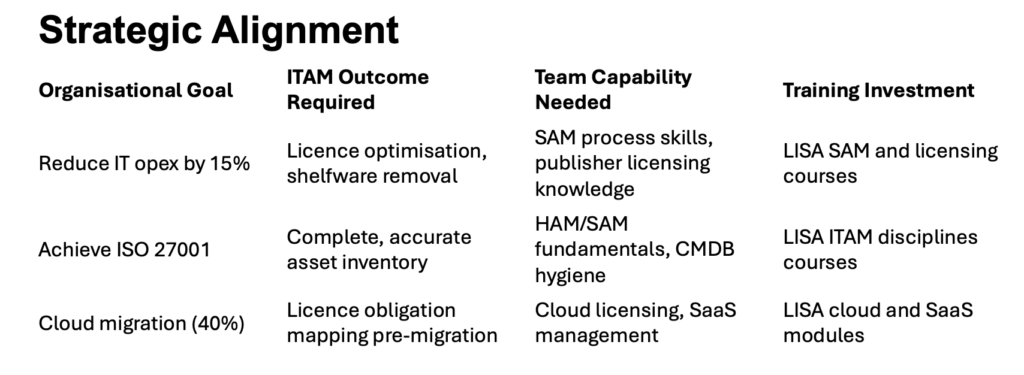
This table should be the first thing your approver sees after the executive summary. It answers the question “why does this matter to us?” before they’ve had a chance to ask it.
Current State and Capability Gaps
The ITAM team manages approximately 8,000 devices and 200 software titles. Asset discovery tooling is in place and CMDB hygiene has improved significantly over the past two years. However, there are material gaps in licensing knowledge and SAM process maturity.
Gaps identified through a recent team self-assessment: limited understanding of Microsoft licensing under hybrid and cloud scenarios; no formal training in Oracle licensing rules despite Oracle representing significant spend; inconsistent approach to audit defence preparation; no team member holds a recognised ITAM or SAM certification; and no process for identifying licence obligations ahead of cloud migrations.
Cost of Doing Nothing
If no training investment is made, Greystone faces direct exposure against all three FY26 goals.
The team currently lacks the skills to conduct effective licence reconciliations independently. At the current rate, external ITAM consultancy will exceed £50,000 in the next 12 months. ISO 27001 certification auditors will expect a complete asset inventory and evidence of controlled processes. The current team cannot produce this to the required standard without external support, estimated at £20,000-£30,000. Without visibility of existing licence obligations, Greystone risks migrating workloads into non-compliant positions, a problem significantly more expensive to fix after migration than before. A Microsoft True-Up is due in Q3, and without improved internal capability external support will again be required, estimated at £25,000-£45,000. Exit interview data from the team member who left last year indicates that lack of development was a primary factor. Replacement cost is estimated at £30,000-£50,000 per person.
Total estimated cost of inaction over 12 months: £125,000-£175,000, excluding any audit settlement costs.
Options Considered
- Option 1: Do nothing. Accept current capability levels and continue managing gaps through external consultancy. Directly undermines the IT cost reduction target. Not recommended.
- Option 2: Recruit a senior ITAM specialist. Estimated cost: £65,000-£80,000 salary plus £10,000-£15,000 in recruitment fees. Creates a single point of failure, doesn’t develop the existing team, and works against the IT opex reduction goal. Not recommended as a standalone solution.
- Option 3: Invest in structured training. Develop all four team members through a certified online training programme. Estimated cost: £X per year. Builds lasting internal capability, directly supports all three strategic goals, reduces consultancy dependency, and supports staff retention. Recommended.
Recommended Solution
We recommend a 12-month subscription to LISA (lisa.training), an independent online training platform dedicated to ITAM, SAM and software licensing professionals. LISA provides on-demand and live training across the major software publishers including Microsoft and Oracle, ITAM disciplines, tools and processes. Courses lead to recognised certifications.
All four team members will be enrolled. Priority courses in the first quarter will focus on Microsoft licensing fundamentals and Oracle compliance, ahead of the True-Up in Q3. Cloud licensing modules will be prioritised in Q2, ahead of the migration programme acceleration in H2.
Expected Outcomes
- Individual: All four team members will complete at least two certified courses within 12 months, each with a documented development pathway and improved confidence in their area of specialism.
- Team: Shared language and consistent approach to licence compliance and SAM processes. Knowledge no longer concentrated in one or two individuals. The team will be equipped to lead the Microsoft True-Up internally and provide licence obligation mapping ahead of cloud migrations.
- Business, mapped to FY26 goals:
IT cost reduction: reduced dependency on external consultants (estimated saving £30,000-£50,000), improved licence optimisation capability (estimated additional saving £20,000-£60,000)
ISO 27001: team capable of producing a complete, auditable asset inventory without external support
Cloud migration: licence obligation mapping completed ahead of each migration wave, avoiding post-migration compliance exposure
Cost and ROI
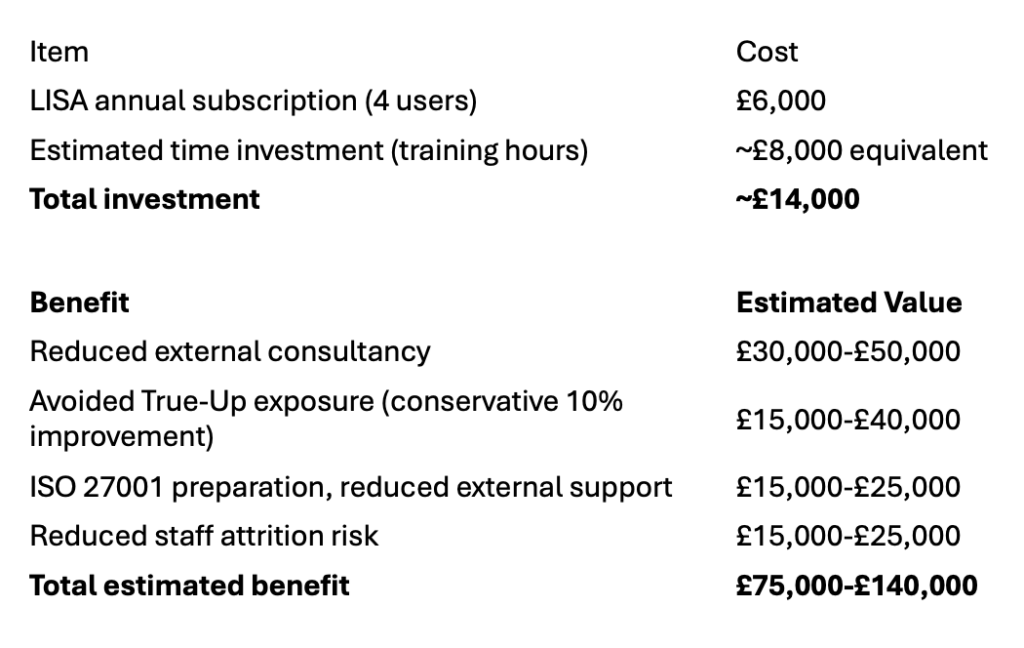 Estimate ROI = 436% – 900% in year one. These figures are conservative and based on known consultancy spend and internal HR data.
(calculated as (benefit – investment) / investment × 100)
Implementation Approach
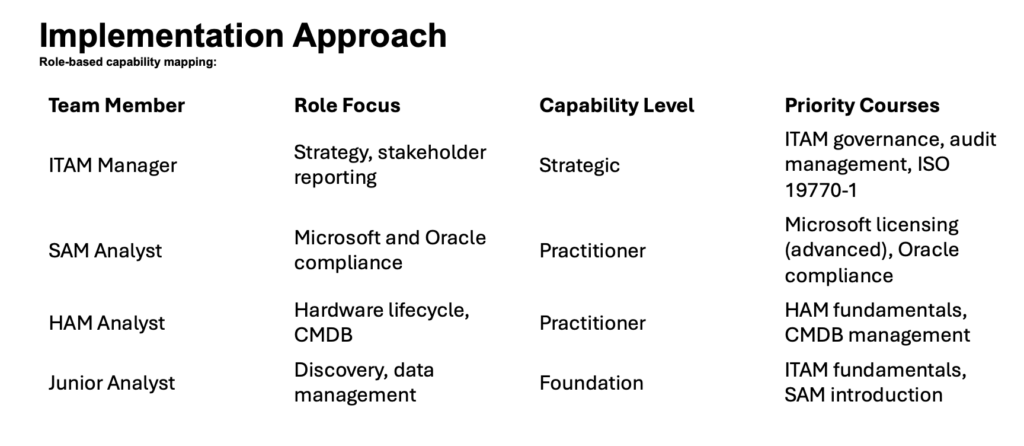 Phased rollout:
- Months 1-2: Platform onboarding, individual learning plans agreed, priority courses identified based on the True-Up timeline and ISO 27001 gap analysis.
- Months 3-6: Microsoft and Oracle licensing modules completed by SAM Analyst. True-Up preparation undertaken using internal capability. Foundation training completed by Junior Analyst.
- Months 5-8: Cloud licensing modules completed ahead of migration programme acceleration. HAM practitioner modules completed.
- Months 7-9: ISO 27001 evidence pack developed by internal team. ITAM Manager completes strategic-level governance modules.
- Months 10-12: Certification exams completed. Review of outcomes against strategic targets. Decision on renewal and expansion.
How we will measure success:
- External consultancy spend (target: reduce by 50% vs prior year)
- Microsoft True-Up completed without external support
- Time to produce a publisher compliance position (baseline established in month 1)
- Percentage of software estate with a current entitlement position on file (target: 80% by month 12)
- All four team members hold at least one recognised certification by month 12
Recommendation
We request approval for an annual LISA training subscription at a cost of £X, funded from the IT training and development budget. This is not a discretionary spend. It directly supports delivery of Greystone’s three FY26 strategic priorities. Approval is sought by [date] to allow onboarding ahead of the Microsoft True-Up in Q3.
Closing
Building a business case for training isn’t the most glamorous part of an ITAM professional’s job. But it might be one of the most important. The teams that consistently deliver, clean audits, optimised spend, strong security posture, trusted data, are the ones that invest in their own capability. They don’t happen by accident.
The research is clear about what the stakes are. The framework above gives you the tools to argue for the investment properly. The golden thread from training plan to team outcome to business goal is what turns a request for budget into a case that’s genuinely hard to refuse.
Good luck getting it over the line!
