
(This article was updated on 27 May 2025)
What’s the difference between SAM & ITAM?
Software Asset Management
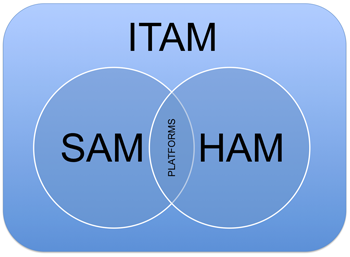
Software Asset Management (SAM) is a subset of ITAM focused exclusively on managing the lifecycle of software assets, whereas ITAM encompasses the management of all IT assets, including both hardware and software.
SAM tends to receive more exposure than ITAM due to the following:
- Software audits are an expensive, compelling focus.
- Software can represent an ongoing operational expense, whereas hardware costs are typically more “one-off” costs.
- Hardware is becoming less relevant since the introduction of Cloud servers.
Despite some clear differences, SAM and ITAM are extremely intertwined. Any effective SAM policy will likely have a direct impact on hardware asset management (HAM), and therefore, any effective ITAM practice will need to ensure that SAM and HAM policies are both well managed.
IT Asset Management
The broader definition of ITAM is also expanding, moving beyond its traditional boundaries of SAM and HAM management, including:
- Cloud Asset Management
- SaaS Management
- Strategic Business Alignment
- Sustainability
In summary, ITAM encompasses SAM, HAM and various other disciplines, to ensure an entire IT estate is successfully managed.

I agree. There is a huge connection between the two disciplines and to full benefit in SAM, HAM needs to be managed as
well. After all, what’s the point of knowing where the licenses are installed if you can’t find the machine they’re installed upon?
There are lots of opportunities to reduce costs in both hardware, software and gain efficiencies in IT service management by
having an effective ITAM practice.
Yes I agree with Mark. HW and SW are treated with different life span in different industry verticals. The frequent
changes in vendor licensing contracts also need to be understood and mapped on contractual dependency.
I couldn’t agree more Martin.
Many software licenses are dependant on hardware details –
think IBM PVU licensing or Oracle database Processor licenses.
This area is made more complex by virtualization and partitioning –
sub-capacity licensing and hard v soft partitioning…
SAM cannot exist in isolation of “HAM” – and too often people try to “do
SAM” without having the basic information about the platforms software is running on correct – this just leads to failed SAM
implementations.
I couldn’t agree more Martin.
Many software licenses are dependant on hardware details – think IBM PVU licensing or Oracle database Processor licenses.
This area is made more complex by virtualization and partitioning – sub-capacity licensing and hard v soft partitioning…
SAM cannot exist in isolation of “HAM” – and too often people try to “do SAM” without having the basic information about the platforms software is running on correct – this just leads to failed SAM implementations.
Software audits are troublesome and inconvenient.
You certainly have the commonality
correct.
I also believe it is time we took our focus off of Software Audits as the business driver for SAM. It rather like only
responding to responsibility after being caught stealing. Better to focus on prevention of creating the constructive liability in the
first place. Just as we do with purchasing approvals before we create liabilities, perhaps it is time to create management controls that
prevent software installs without management controls. Perhaps a new focus on not overlicensing as well – where the real waste is.
I would say, however, that we need to add in Virtual environments into the mix. High-speed, automated provisioning of VMs and VDI
will create a new demand for management controls over sprawl.
This is a very elegant description. However, there is possibly a third
circle in the Venn diagram; contracts. Both SAM and HAM have a contractual dependency. It is all well and good knowing what assets you
have, but without understanding the terms under which you have them you miss a very important part of the picture.
The Hardware data can be used for completeness check of the Software data
and vice versa. First impression is that Hardware is ‘more easy’ to count and can not be installed more as purchased physically. But
virtualisation and paramaters hampers this. Counting of software might be used to discover ‘illegal’ hardware installations.
Both
areas have in common that terminology is not standard, not transparant and not shared between HAM and SAM vendors.
ITAM should develop
a strategy to reduce the complexity to control HAM and SAM.
I agree with the comments above, the ITAM / HAM /SAM diagram is very good, but I think Mark is right that there
is one more dimension that is missing that covers the licensing contracts, which can have special negotiated terms and conditions that
utterly change the license liability. In our organisation, we call this LAM – Licensing Asset Management.
Good point. The connection between SAM and HAM require that one be managed just as well as the other.
Just as solutions for hardware efficiency abound, software and IT asset management tools should be tapped, and good practices need to be in place.